7 Signs Intergenerational Trauma Is Affecting Your Postpartum Mental Health (and How to Respond)
A few weeks ago my son came home from fourth grade talking about California history. His teacher told the class that everyone has an immigration story. Somewhere back however many decades, someone in our family arrived from somewhere else. It sent me down a rabbit hole about my own four grandparents, all of whom I was lucky enough to know. Only my Portuguese grandmother is still with us today.
One of my grandmothers survived in a refugee camp after the Nazis took her native home of Czechoslovakia and came to the United States as a war bride. My grandfather (her husband) came from a family that originated in Scotland but settled in the South. My other grandfathers family left Ireland for California because staying meant staying in poverty. My Portuguese grandmothers family left the Azores for the same reason - there was no future for her children if she stayed.
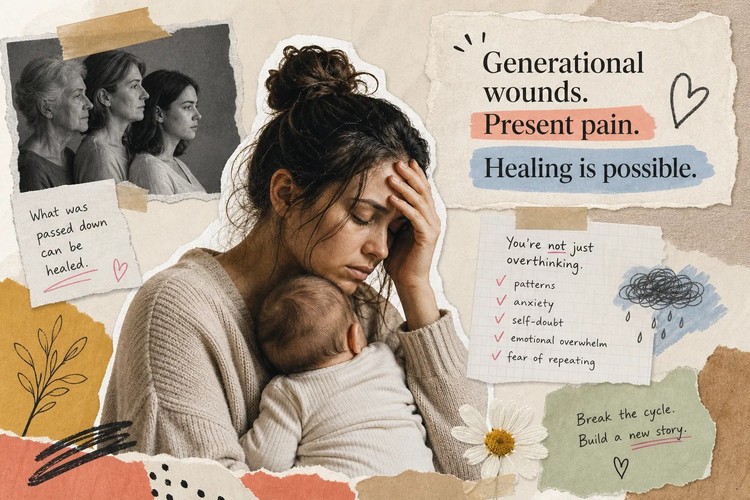
All four were born in the 1930s and 40s and lived through some combination of war, the Great Depression, and displacement that I will never have to live through myself. And yet I know, without question, that it's in me anyway. This is intergenerational trauma - the psychological, relational, and sometimes biological transmission of a trauma's effects from one generation to the next, often without the descendant ever experiencing the original event.
How intergenerational trauma actually gets passed down
My Portuguese family has a well-documented history of depression and anxiety, including postpartum depression specifically. My grandmother who survived the Nazi Germany developed her own coping patterns, including a gambling habit and a lifelong need for nice things she couldn't always afford, as if part of her never stopped bracing for everything to be taken away again.
Research on this is still developing, but it's compelling. Studies of children and grandchildren of Holocaust survivors have found elevated cortisol and higher rates of nightmares in descendants who never lived through the Holocaust themselves. A similar pattern shows up in descendants of enslaved people. It isn't that they experienced the event directly; it's that they were already predisposed toward a heightened stress response, and then grew up absorbing the message: always be on alert, you are not safe here, it is dangerous to simply exist as you. That gets absorbed long before a child has words for it.
I'm also spending a lot of time here referencing immigration trauma but there is more to intergenerational trauma than just that. Families that have histories of domestic violence, systemic oppression, or poverty can also pass down their own inherited sense of anxiety and depression.
7 signs intergenerational trauma may be shaping your postpartum experience
Almost every mother I work with has some version of an immigration story (and/ or other traumas) whether she's thought of it that way or not. Here's where this tends to show up in the postpartum period, often with no connection to anything happening in her present-day life.
1. Anxiety or hypervigilance that doesn't match your circumstances. A loving partner, a safe home, nothing objectively wrong... and still, a current of anxiety running constantly, or a dread you can't quite trace to anything real.
2. Depression that doesn't seem to be about anything. A heaviness or numbness that just seems to exist without a clear trigger. When postpartum depression has roots in inherited trauma, it often feels less like sadness and more like a fog that was always there, just quieter before the baby arrived.
3. A sense of never being enough. Shame or self-doubt that spikes specifically in motherhood and a fear of being fundamentally unqualified, or of repeating your own mother's mistakes, even in women who have worked hard and know exactly who they are.
4. Trouble bonding with your baby. A sense of distance or numbness during feeding or holding. Attachment disruption is one of the clearest ways inherited trauma moves across generations.
5. Repeating what you swore you'd never repeat. My mom behaved like that, and I remember absorbing her anxiety as a kid even though I didn't have a word for it yet. I told myself I'd never be that parent. Then motherhood arrives, and it shows up anyway because it's the only template your nervous system has ever known.
6. Relationship Instability or trust difficulty: Postpartum stress can expose what was already there. You may have had perfectionism challenges, intimacy issues, people pleasing habits, etc. but you were able to appropriately mask them up until now. The postpartum season blows that all open.
7. Physical symptoms with no clear medical cause. Chronic tension, disrupted sleep, headaches, gut issues, or fatigue that "just runs in the family." In descendants of enslaved people, refugee communities, and many immigrant families, talking openly about mental health was never an option so the pain emerged through the body. Trauma also lives in the body and the nervous system, alongside whatever is happening biologically.
Why you can't just think your way out of it
Trauma and anxiety are not cognitive problems. If insight alone were enough, none of us would still be stuck. This lives in the nervous system, not the intellect which is why you can challenge a thought in session and still find yourself snapping at your kid on a rushed morning. In that moment, your body isn't reasoning. It's reacting from somewhere much older.
This is why I lean on therapies that get to the root of the issue. Accelerated Resolution Therapy (ART) maps where a feeling lives in the body, along with the imagery attached to it, and helps the nervous system find somewhere new to go. Bonus points: no need to talk through every detail, since a lot of this material is pre-verbal. Ketamine-Assisted Psychotherapy (KAP) creates space to meet the parts of you carrying beliefs that were never actually yours (men aren't safe, I'll never be the mother I want to be, it's never enough). These are belief patterns that maybe our ancestors held for good reason but we no longer need to hold on to. KAP can open a door to see what's possible outside of them, sometimes even creating room to meet your ancestors in a genuinely spiritual way and consciously set down what they carried.
Where to start
We begin with a full history: your birth, what you know about your mother's experience giving birth to you, what you know or were told about your grandparents. Almost everyone starts the same way, "I had a good childhood, I don't know what's wrong with me" and then, gently, more comes up. That's usually where the real work of healing generational trauma begins.
Most of us carry some version of this. Being able to meet the parts of yourself holding beliefs that were never really yours, and set them down instead of handing them to your own child, is one of the most meaningful things you can do for yourself, and for the ones who come after you. The cycle stops here.
